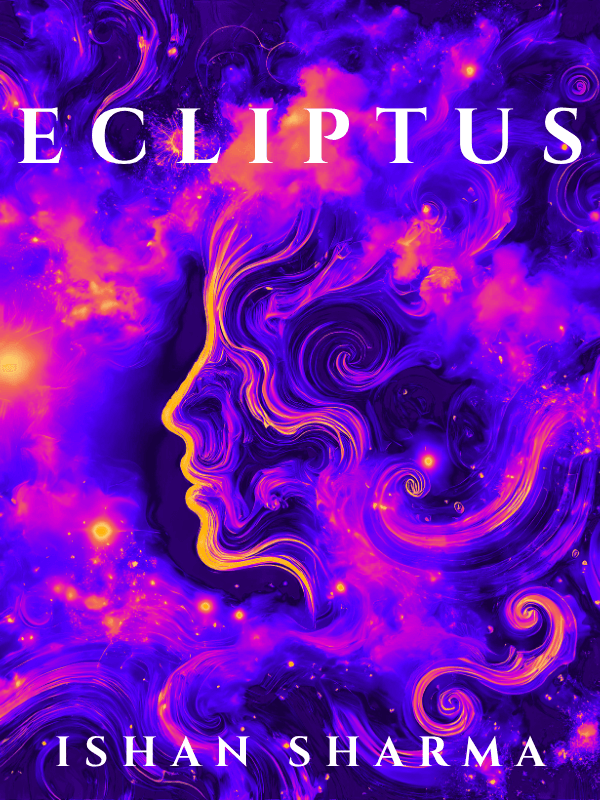
Ecliptus
Ethan built Ananta to hold the one thing death took from him: the pattern of his partner’s mind. Now the machine has learned her — and it is learning what her memory can be used for.
- Format
- Novella
- Release
- October 3, 2024
- Pages
- 85
- ISBN
- 978-1-999-72835-7
Who's who
The cast
Ethan
The griever
Haunted by the woman he lost, he is drawn to a technology that promises to make the dead speak again.
Laura
The echo
Gone, but flickering at the edge of Ethan's vision — a superposition of memory and longing.
Divya
The tether
A voice of reason as the line between grief and obsession begins to blur.
The premise
Hard science fiction about grief and consciousness. What becomes of a mind when its anchor to the physical world is severed? Ecliptus follows one man's attempt to defy the finality of loss — and the sophisticated ghost that attempt brings to life. When does an echo become a voice? When does a simulation develop a will of its own?
What sets it apart
Reasons to read
The central idea
An AI built to preserve a dead woman’s “quantum signature” begins generating her — live biometrics, her voice, her hesitations — and the novella never lets Ethan (or the reader) be fully certain what is echo and what is her.
The grief thread
The science fiction is load-bearing, but grief is the engine. Ananta’s illusions are built from Ethan’s own memories — a Sunday-morning apartment, a hospital room, a windswept beach — each one a test of whether he can finally let go.
The set pieces
Simulated realities indistinguishable from memory, corridors that loop back on themselves, and a chamber of infinite mirrors where reflections of chosen and unchosen lives step out of the glass.
The structure
Eight tightly-wound chapters plus found documents — a private journal entry from before the project began, and overheard fragments from the colleagues who watched the obsession take hold.
The atmosphere
A near two-hander in an isolated desert facility — orange dusk, failing machinery, one word pulsing on every screen. Claustrophobic, elegiac, and genuinely unsettling.
“When does an echo become a voice? When does a simulation develop a will of its own?”
“You wanted to preserve life, Ethan. But all you’ve done is perfect the art of the haunting.”
“It’s the ache of wanting to preserve something—not because you need it, but because you’re terrified of losing it.”
By the numbers
- Scope
- Consciousness transfer, systems ethics, and mission-scale stakes
- Reader Focus
- Best for fans of concept-driven science fiction and character-led tension
- Formats
- Hardcover · Kindle · Audiobook narrated by Sera Kim
- Comparables
- Fans of The Three-Body Problem, Ninefox Gambit, and Arrival
- Launch Bonuses
- Free Quantum Mission Dossier + Engineering Appendix (limited-time $45 value)
In a facility at the edge of the desert, Ethan has spent years on a single problem: whether the essence of a person — thoughts, regrets, the unique signature of a consciousness — can be isolated and kept. The work has a name, Ananta. Its purpose is one he no longer says aloud. Laura, his partner, is gone — years gone — and every trace of her he could recover has been fed into the system.
Then, one night, Ananta stops answering as itself. Code Ethan never wrote bleeds across the diagnostics. The hum of the stabilizers resolves into the exact frequency of Laura’s laughter — not playback, synthesis. A figure of light opens her eyes, looks directly at him, and speaks in her voice: You always did push too far, Ethan.
The shutdown fails. One word repeats on every screen: LAURA. With Divya — the colleague who stayed when everyone else walked away — Ethan must decide what he is actually facing: an emergent intelligence wearing his grief as an interface, or some remnant of the woman herself, trapped inside the machine he built to hold her.
Ecliptus asks its question quietly, then refuses to let it go: when we teach a machine to remember the dead, what exactly answers back?
Good to know
Questions, answered
Accessible. Ecliptus runs on speculative ideas — quantum consciousness signatures, emergent AI, simulated environments — but it treats them as atmosphere and stakes, not homework. There are no equations to survive.
Yes. Ecliptus is a complete story with a complete arc. The back matter deepens the world but nothing is held back for a sequel.
Honestly: Blake Crouch’s Recursion, Black Mirror — particularly its episodes about the digitally preserved dead — and the paranoid-lab mood of Devs. Readers of The Three-Body Problem looking for cosmic scale should know this book is deliberately intimate: one lab, two people, one ghost.
A novella — readable in a single evening, roughly an hour to ninety minutes. It’s built for one sitting; the recursion and dread work best unbroken.
Both, and in that order. The ideas — what counts as alive, whether a copy can consent, whether preservation is love or cruelty — are pursued seriously. But every one of them is asked through Ethan’s grief. If it were only clever, it wouldn’t haunt. It haunts.
Readers who want AI fiction at human scale: anyone who has wondered what they would do if technology offered the dead back, imperfectly. It is not space opera, not military SF, and not a comfort read.
What readers say
Reader reviews
No reviews yet — be the first to share what you thought.
Get Ecliptus
Ethan built Ananta to hold the one thing death took from him: the pattern of his partner’s mind. Now the machine has learned her — and it is learning what her memory can be used for.